They told you there is no blacklist
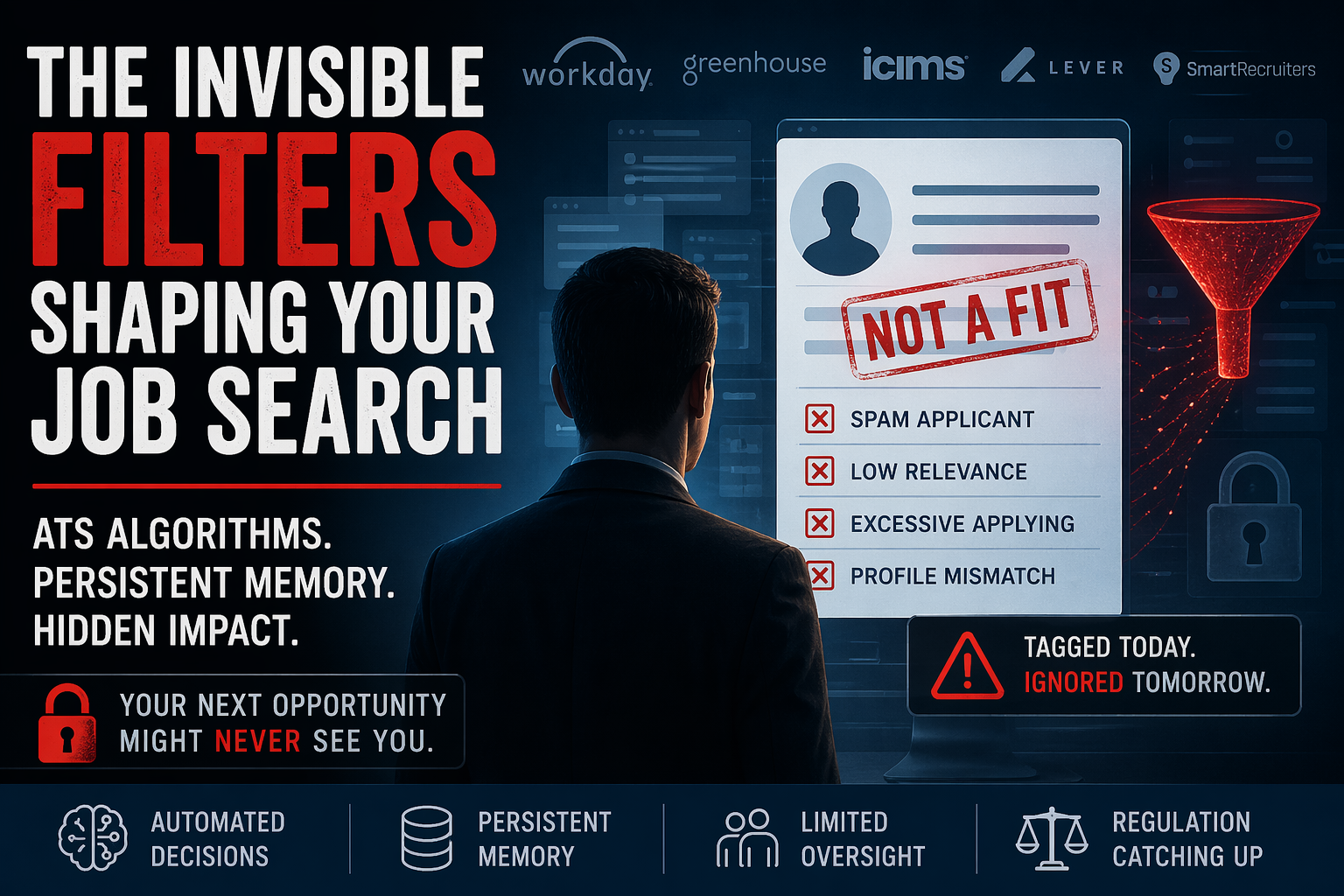
They told you there’s no blacklist.
They told you there’s no blacklist.
They lied. (Just not how you think.)
The machinery: Your ATS “spam flag” is a life sentence
Let’s name the systems doing this. These are not fringe tools. They power the majority of UK and EU hiring.
🔥 Greenhouse
Marketed as “structured hiring.” Behind the scenes, a permanent “spam” tag. Once clicked, future applications from that email are automatically rejected forever. No appeal. No notification.
⚡ Ashby
Built fraud detection into its ATS in 2025. Scans devices, IP addresses, phone numbers. Public Wi‑Fi? Too many apps? Flagged. That flag silently deprioritises every future application.
🏢 Workday
22% market share. Its “duplicate management” merges old applications with new ones. Attached to that old profile? A “Do Not Hire” note from years ago. One bad day, one misunderstood CV — and you’re toxic across that entire enterprise.
📎 iCIMS
Used by staffing agencies feeding into hundreds of clients. Knockout questions filter you out instantly. Fail one by a narrow margin? You’re gone. Permanently.
🔄 Lever
Built for “talent rediscovery.” Means your historical application, including every negative note a recruiter ever left, resurfaces each time you apply again.
These aren’t bugs. They’re features. And the real victim? The “desperate” job seeker.
🎯 The real victim: job seekers who apply intensively
“Spam” in ATS logic is defined by frequency, velocity, and pattern matching. Apply to 50 jobs in a week? The system sees volume, not desperation. Reapply after six months? The system merges your profile – and remembers the old “not a fit” tag. The unemployed are systematically penalised for acting like unemployed people.
Data sharing: The dirty secret they won’t admit
Officially, ATS vendors do not share candidate blacklists between companies. Unofficially? They don’t need to. Recruitment agencies use the same ATS backend. Enterprise groups share internal hiring infrastructure. Exported candidate data – including those “spam” flags – gets reused across contexts. A temporary agency flags you for “over‑applying.” That agency supplies staff to twenty different firms. That flag now exists, in practice, across all of them. No global blacklist. Just a federation of local ones. The effect is identical.
The law is weak. The AI Act tries – but probably fails.
The EU AI Act classifies recruitment systems as “high‑risk.” That means mandatory human oversight. But here’s the loophole the industry is already using: “Human oversight” does not mean “recruiter actually reads your application.” It means a human can theoretically override the system. In practice, volume guarantees they won’t.
Article 22 of the GDPR gives you the right to contest solely automated decisions. But how do you contest a decision you never knew existed? The ATS doesn’t tell you: “You were rejected because a system flagged you as spam three years ago.” The UK’s Blacklisting Regulations (2010) were written for paper lists. They do not mention algorithmic profiling. They are legally obsolete.
The uncomfortable truth
The recruitment industry has outsourced judgement to machines that were never designed for fairness. They optimise for speed and risk reduction, not talent discovery. They reward predictable, linear career paths. They punish career changers, the long‑term unemployed, and anyone who doesn’t fit a clean data profile. This is not a conspiracy. It’s structural indifference dressed up as efficiency.
What you can actually do about it
You cannot delete your ATS shadow profile. But you can make it irrelevant.
- Diversify your application channels. Do not rely on any single job board or ATS portal.
- Use a jobseeker support system that aggregates across platforms – so no single flag determines your fate.
- Where possible, apply through direct human contact. Referrals and networking bypass the algorithmic filter.
- Demand transparency. Under GDPR, you can request your data from any company. Ask for “all automated decision‑making logic and any profile scores.”
📌 Final word: There is no central blacklist. But there are thousands of local ones. And together, they form a shadow infrastructure that decides your employability before any human sees your name. Call it profiling. Call it risk scoring. Call it spam filtering. The outcome is the same: you are being judged by machines that were never built to be fair.
Your next step
Don’t let a hidden flag control your career. Use a system that sees across every board — and fights back against silent profiling.
👉 GetJobzi.com — Register for freeUpload your CV once. Jobzi aggregates 766+ data streams and 12 major job boards — so no single flag decides your future.